Who needs simple precautions, and who needs an individual medical plan
“Doctor, I have a long flight next month. Should I take aspirin before I travel?”
This is one of the most frequent questions I receive before long-distance travel. The concern is understandable, but prevention should match the traveller’s actual risk. Most healthy people do not need medication before a flight.
Long-distance travel is associated with a small increase in the risk of venous thromboembolism, which includes deep vein thrombosis and pulmonary embolism. For flights longer than four hours, published estimates place the absolute risk of symptomatic venous thrombosis at approximately one event per 4,600 to 6,000 person-flights. The risk is low in healthy travellers, but it rises with longer journeys and with pre-existing risk factors.
Why can long travel increase the risk?
The main mechanism is prolonged immobility. When the calf muscles contract, they help return venous blood from the legs towards the heart. Sitting for several hours reduces this pumping effect and promotes venous stasis. Pressure from the edge of the seat behind the knee may reduce venous flow further.
This is not unique to air travel. Long journeys by car, bus or train can produce a similar problem when movement is restricted. Cabin-related factors, including lower oxygen pressure, may contribute in susceptible travellers, but the available evidence consistently points to immobility as the main concern.
Dehydration is often presented as a major cause of travel-related thrombosis, but a direct association has not been demonstrated. Drinking water is sensible for general comfort and wellbeing during travel, but it should not be described as a substitute for movement or as a proven thrombosis-prevention measure.
Who is at increased risk?
Risk assessment is more useful than applying the same advice to everyone. Important risk factors include:
- A previous deep vein thrombosis or pulmonary embolism.
- Active cancer or recent cancer treatment.
- Recent major surgery, hospitalisation or significant trauma.
- Pregnancy and the postpartum period.
- Use of oestrogen-containing contraception or hormone replacement therapy.
- Known inherited or acquired thrombophilia.
- Restricted mobility, paralysis, a leg cast or a significant recent leg injury.
- Older age, particularly when combined with other risk factors.
- A strong family history of venous thrombosis.
The number and strength of the risk factors matter. A healthy traveller with no relevant history is not in the same category as a patient with previous unprovoked thrombosis, active malignancy or recent surgery. Combinations of moderate risk factors may also become clinically important.
What should most travellers do?
For a healthy person without additional risk factors, simple measures are usually sufficient:
- Walk when it is safe to do so, particularly during longer flights.
- Perform regular ankle movements and calf contractions while seated.
- Choose an aisle seat when practical if this makes it easier to move.
- Avoid sitting with the legs crossed for prolonged periods and avoid clothing that is markedly restrictive at the groin or waist.
- Drink according to thirst and limit excessive alcohol, mainly because alcohol may increase immobility and worsen dehydration or sleepiness.
There is no precise evidence-based timetable for movement. The practical aim is to avoid remaining completely still for many hours.
When are compression stockings useful?
Properly fitted, below-knee graduated compression stockings can reduce asymptomatic deep vein thrombosis and also help with travel-related leg swelling. Guidelines commonly refer to stockings that provide 15-30 mmHg pressure at the ankle for travellers at increased risk.
They are not routinely required for every healthy passenger. Correct sizing matters. A stocking that is too tight, folds or rolls down can cause discomfort and local pressure. Patients with significant peripheral arterial disease, severe skin disease or unusual leg anatomy should seek advice before using them.
What about aspirin or anticoagulants?
Aspirin should not be taken routinely before a flight. Venous thrombosis is driven mainly by venous stasis and activation of coagulation, while aspirin acts primarily on platelets. It is therefore not the preferred preventive treatment for travel-related venous thrombosis, and it can cause bleeding or gastric irritation.
There is a limited exception in current guidance. For travellers at substantially increased risk, the American Society of Hematology suggests graduated compression stockings or prophylactic low-molecular-weight heparin. If neither is feasible, aspirin may be considered rather than no prophylaxis. Other guidelines advise against routine aspirin or anticoagulants for travel. This is why medication should be decided individually rather than taken “just in case”.
Low-molecular-weight heparin may be appropriate for selected high-risk travellers, but the dose and timing require medical assessment. Direct oral anticoagulants are convenient, but evidence for using them specifically to prevent travel-related thrombosis remains insufficient.
If you already take an anticoagulant for another indication, continue it exactly as prescribed. Do not add aspirin, take an extra dose or change the timing without advice from the clinician managing your anticoagulation.
When do travel-related clots appear?
A clot does not need to become apparent during the flight. Most travel-associated events occur within the first one to two weeks after the journey, and the excess risk gradually returns to baseline by approximately eight weeks.
Symptoms that require assessment
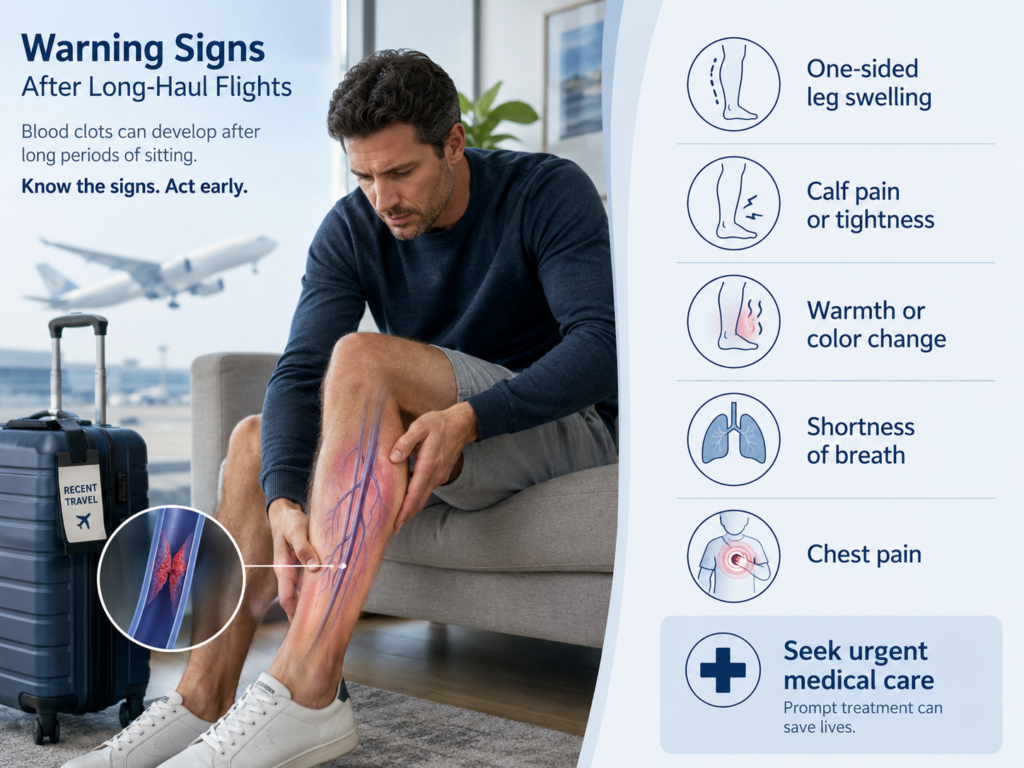
Seek urgent same-day medical assessment for possible deep vein thrombosis if you develop new swelling, pain, tenderness, warmth or discolouration affecting one leg, particularly when the symptoms are more marked in the calf or thigh.
Sudden unexplained shortness of breath, chest pain that is worse on breathing, coughing blood, fainting or severe unexplained palpitations may indicate pulmonary embolism and require emergency assessment.
General stiffness or swelling affecting both ankles after a long journey is common and is not the same as a unilateral painful swollen leg. Symptoms alone cannot confirm or exclude a clot; imaging is required when thrombosis is suspected.
Should you cancel the trip?
For most people, no. Long-distance travel is safe when the precautions are proportionate to the individual risk.
A pre-travel medical review is advisable if you have had a previous thrombosis, have active cancer, are pregnant or recently postpartum, have had recent major surgery or trauma, have a leg cast, or have several risk factors together. Patients with a recent diagnosis of deep vein thrombosis or pulmonary embolism need specific advice on when it is safe to fly.
The correct approach is neither to ignore the risk nor to medicalise every journey. Assess the traveller, encourage movement, use compression when appropriate and reserve medication for the small group in whom the expected benefit outweighs the risk.
References
- Reyes NL, Abe K. Deep Vein Thrombosis and Pulmonary Embolism. In: CDC Yellow Book 2026: Health Information for International Travel. Centers for Disease Control and Prevention. Updated 23 April 2025.
- Schünemann HJ, Cushman M, Burnett AE, et al. American Society of Hematology 2018 guidelines for management of venous thromboembolism: prophylaxis for hospitalized and nonhospitalized medical patients. Blood Adv. 2018;2(22):3198-3225.
- Kahn SR, Lim W, Dunn AS, et al. Prevention of VTE in nonsurgical patients: Antithrombotic Therapy and Prevention of Thrombosis, 9th ed. Chest. 2012;141(2 Suppl):e195S-e226S.
- Clarke MJ, Broderick C, Hopewell S, Juszczak E, Eisinga A. Compression stockings for preventing deep vein thrombosis in airline passengers. Cochrane Database Syst Rev. 2021;4(4):CD004002.
- Kuipers S, Cannegieter SC, Middeldorp S, et al. The absolute risk of venous thrombosis after air travel: a cohort study of 8,755 employees of international organisations. PLoS Med. 2007;4(9):e290.
- Chandra D, Parisini E, Mozaffarian D. Meta-analysis: travel and risk for venous thromboembolism. Ann Intern Med. 2009;151(3):180-190.
- Cannegieter SC, Doggen CJM, van Houwelingen HC, Rosendaal FR. Travel-related venous thrombosis: results from a large population-based case-control study (MEGA study). PLoS Med. 2006;3(8):e307.
Medical disclaimer
This article is intended for general information and education only. It does not constitute medical advice and is not a substitute for an individual clinical assessment, diagnosis, or consultation with a qualified healthcare professional. If you have symptoms, concerns about your health, or questions about treatment, please speak to your doctor. Seek urgent medical attention for severe, sudden, or rapidly worsening symptoms.