Five things worth getting right
Blood cancers are still surrounded by misconceptions. Some come from outdated information, while others come from assumptions that seem logical but are not necessarily true.
Leukaemia, lymphoma and myeloma are very different diseases, and even within these groups there are many subtypes with different behaviour, treatment and prognosis.
Here are five common myths worth clarifying.
Myth 1: A diagnosis of blood cancer is always a death sentence
Fact: Many blood cancers are treatable, some are curable, and others can be controlled for many years.
Treatment in haematology has changed enormously. Targeted therapies, monoclonal antibodies, immunotherapy and cellular therapies have transformed the outlook for several diseases.
Chronic myeloid leukaemia is one example. Modern targeted therapy has changed a disease that once had limited treatment options into one that can often be controlled long term.
This is also why old survival statistics found online should be interpreted carefully. Prognosis depends on the exact diagnosis, disease characteristics, age, general health and available treatments.
Myth 2: Leukaemia is mainly a childhood disease
Fact: Leukaemia can occur at any age.
Acute lymphoblastic leukaemia is strongly associated with childhood, which may be where this misconception comes from.
However, several other types of leukaemia occur predominantly in adults, particularly older adults.
The word leukaemia alone tells us very little. The exact subtype matters.
Myth 3: Blood cancer is contagious
Fact: You cannot catch blood cancer from another person.
Leukaemia, lymphoma and myeloma cannot be transmitted through touching, sharing food, saliva or ordinary close contact.
Blood cancers develop when cells involved in blood formation or the immune system acquire changes that allow them to grow or behave abnormally.
Some infections can increase the risk of developing particular lymphomas, but this does not make the cancer itself contagious.
Myth 4: An abnormal blood count means I have leukaemia
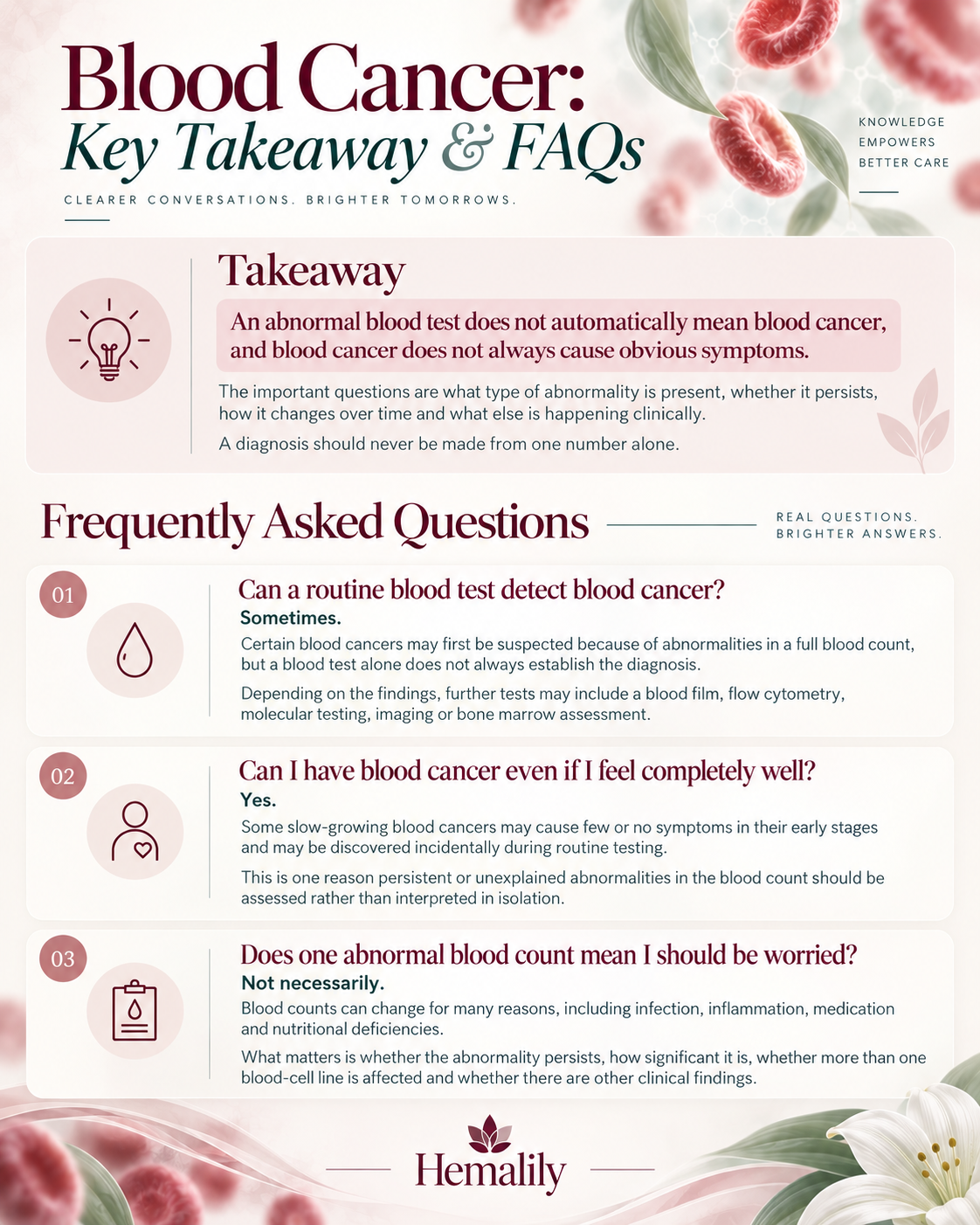
Fact: An abnormal blood count is a finding, not a diagnosis.
Blood counts can change for many reasons, including infection, inflammation, nutritional deficiencies, medications, pregnancy and autoimmune conditions.
What matters is the pattern. Is the abnormality persistent? Is one cell line affected or several? Is it becoming more pronounced over time? Are there other clinical findings that need investigation?
Sometimes repeating the blood count is enough. At other times, further testing may be required.
A single abnormal result should always be interpreted in context.
Myth 5: Blood cancer always causes obvious symptoms
Fact: Not always.
Some aggressive blood cancers can cause symptoms relatively quickly. Others may remain silent for a long time.
Chronic lymphocytic leukaemia and some slow-growing lymphomas, for example, may be discovered during routine blood tests in people who otherwise feel well.
Symptoms such as persistent unexplained lymph-node enlargement, recurrent fever, drenching night sweats, unexplained weight loss, unusual bruising or persistent changes in the blood count deserve medical assessment.
But feeling well does not always mean that everything in the blood count will be normal.
A final thought
Blood cancer is not one diagnosis, and an abnormal blood test is not automatically cancer.
The most useful question is rarely, “What happens to people with blood cancer?”
“What does this particular finding or diagnosis mean for me?”
That answer depends on the individual clinical picture.
Further reading
Reliable patient information and further reading:
- National Cancer Institute — Leukemia
- Blood Cancer UK — Signs and symptoms
- NHS — Chronic myeloid leukaemia treatment
Medical disclaimer
This article is intended for general educational purposes only and does not replace individual medical advice, diagnosis or treatment. Blood cancers are a diverse group of diseases, and symptoms and blood-test abnormalities should always be interpreted in the context of the individual patient. If you are concerned about your symptoms or blood-test results, please discuss them with your doctor or haematology team.