Five more things worth getting right
In Part 1, I looked at some of the most common misconceptions surrounding blood cancer diagnosis and symptoms.
But confusion does not stop at diagnosis. Questions about heredity, transplantation, lymphoma treatment and even the decision not to start treatment immediately can be equally difficult to understand.
Here are five more myths worth clearing up.
Myth 6: If nobody in my family has had blood cancer, I am safe
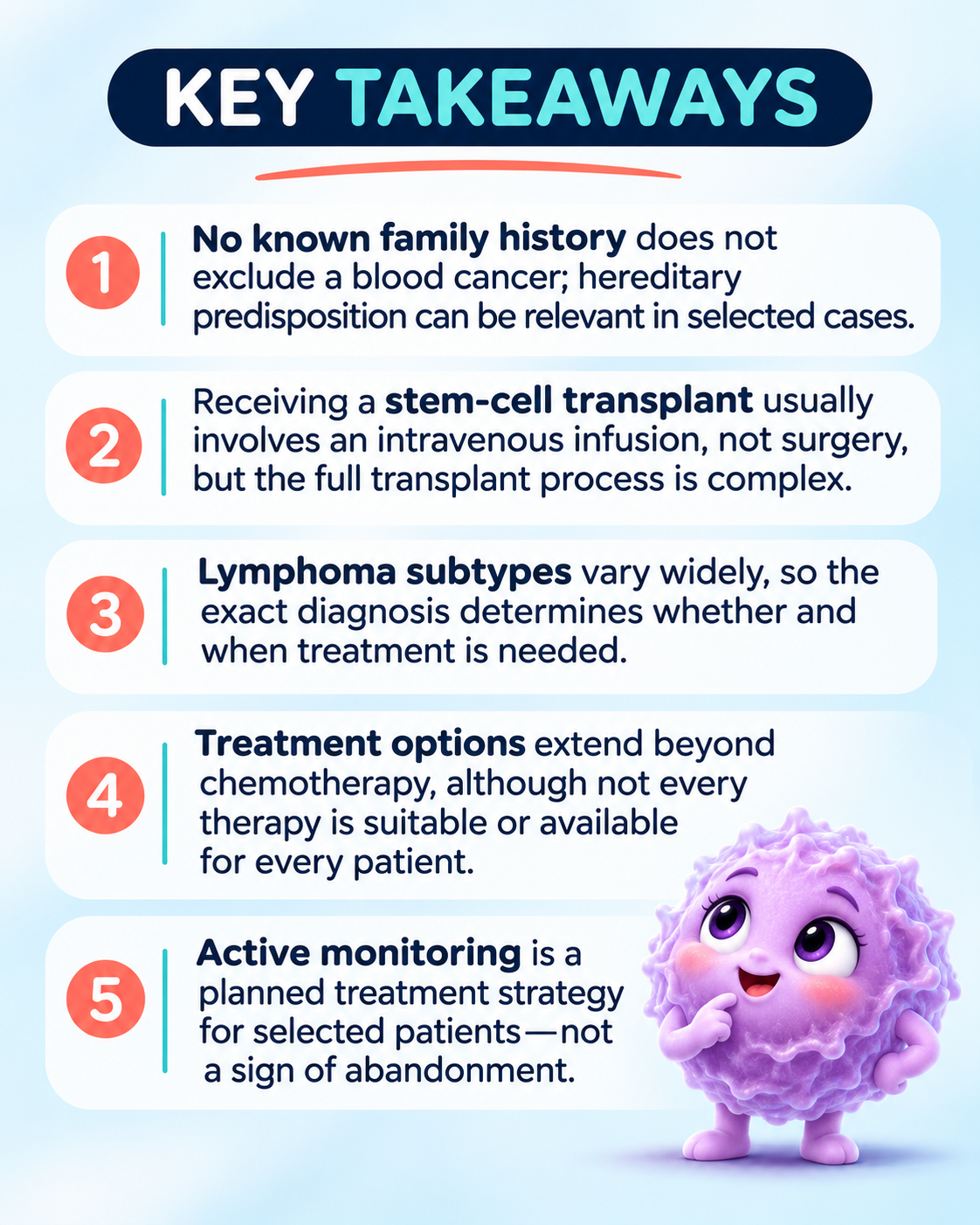
FACT Most blood cancers are not explained by a simple inherited pattern.
Many genetic changes found in blood cancer cells are acquired during a person’s lifetime rather than inherited from a parent. However, inherited predisposition to certain haematological malignancies is increasingly recognised, and it may be relevant even when there is no obvious family history. [1]
Family history is therefore important, but it is only part of the assessment. Having no relatives with blood cancer does not rule it out. Equally, having a relative with blood cancer does not mean you will inevitably develop one.
Myth 7: A stem cell transplant is major surgery
FACT For the person receiving a stem cell transplant, the stem-cell infusion is not a surgical operation.
Blood-forming stem cells are infused into a vein, usually through a central venous catheter, in a process that resembles a blood transfusion. The complexity lies in the treatment surrounding transplantation: conditioning therapy, infection and bleeding risks, immune recovery and other potential complications. [2]
A useful distinction: collecting stem cells from a donor is a separate process. Peripheral blood stem-cell donation is usually performed by apheresis, whereas bone marrow collection may involve a procedure under anaesthesia. [3]
The infusion itself is often one of the simplest steps in a demanding course of treatment.
Myth 8: All lymphomas are basically the same
FACT Lymphoma is not one disease.
There are many lymphoma subtypes, and their behaviour can differ substantially. Some grow quickly and need timely treatment. Selected slow-growing lymphomas can be monitored for months or years when they are not causing problems; others still require treatment based on their stage, symptoms or impact on organs. [4] [9]
This is why an accurate pathological diagnosis, including the lymphoma subtype, matters. It influences treatment, prognosis and follow-up.
Myth 9: Chemotherapy is the only treatment for blood cancer
FACT Modern haematology offers more than chemotherapy.
Depending on the diagnosis, treatment may include targeted medicines, monoclonal antibodies, chemotherapy, immunotherapy, bispecific antibodies, stem cell transplantation or cellular therapies such as CAR-T cells. These are established options for selected diseases and clinical situations, not interchangeable treatments for every blood cancer. [5] [6]
Chemotherapy remains essential for several malignancies. Increasingly, the specific biology of the disease, the stage, previous treatment and the patient’s circumstances guide the choice of therapy. Availability also differs between health systems.
Myth 10: “Watch and wait” means my doctor has given up on me
FACT Active monitoring can be the recommended evidence-based approach.
Some people with asymptomatic chronic lymphocytic leukaemia (CLL) or selected indolent lymphomas do not need treatment at diagnosis. For appropriately selected patients, starting treatment before there is a clinical indication has not been shown to improve overall survival in some settings, while it can expose them to side effects. [7] [8] [9]
“Watch and wait” does not mean doing nothing. The medical team reviews symptoms, blood counts and examination findings, and starts treatment when established clinical indications develop. New or worsening symptoms should be reported rather than waiting automatically for the next scheduled visit.
Not treating now is not the same as having no treatment available.
A final thought
Blood cancer treatment has changed considerably, and it continues to change. Two people may both say they have lymphoma, leukaemia or myeloma and yet have very different diseases, different treatments and different expectations for the future.
The name of the disease is only the beginning of the conversation. Understanding the subtype, its biology and why a particular treatment—or sometimes active monitoring—has been recommended is more helpful than comparing one diagnosis with another.
References and original sources
The titles and citation numbers below are clickable links to the original sources.
[1] National Cancer Institute (NCI). Genetics of Hereditary Hematologic Malignancies (PDQ®). · Open original page
[2] NCI. Stem Cell Transplants in Cancer Treatment. · Open original page
[3] National Marrow Donor Program (NMDP). About Blood Stem Cell Donation. · Open original page
[4] NCI. Non-Hodgkin Lymphoma Treatment (PDQ®)—Patient Version. · Open original page
[5] NCI. CAR T Cells: Engineering Immune Cells to Treat Cancer. · Open original page
[6] NCI Dictionary of Cancer Terms. Bispecific T-cell engager. · Open original page
[7] Blood Cancer UK. Active Monitoring Explained. · Open original page
[8] NCI. Chronic Lymphocytic Leukemia Treatment (PDQ®)—Health Professional Version. · Open original page
[9] Lymphoma Action. Active Monitoring (Watch and Wait). · Open original page
Medical disclaimer
This article is intended for general education only and is not a substitute for individual medical advice, diagnosis or treatment. Decisions about monitoring and therapy depend on the exact diagnosis, disease characteristics and clinical circumstances. If you have questions about your results, symptoms or treatment plan, discuss them with your haematology team.